Intro
It had been a while since I last took the time to reverse a real malware sample from scratch.
To avoid getting rusty (and because it’s genuinely fun), I gave myself a simple challenge: grab a completely random malware sample and see how far I could go analyzing it.
Off to MalShare, random click, download a binary without knowing what I was getting into.
Spoiler: it wasn’t a crappy crack — it was a fairly ambitious stealer, with password theft, Discord tokens, encryption, and the usual toolkit.
Fingerprints
First data points:
1 | File: malware |
At the time this article is written, these identifiers are already known (VT, etc).
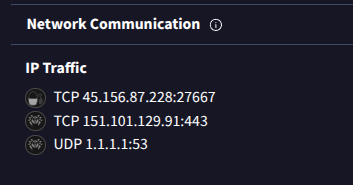
However, the IoCs (especially contacted IPs) do not fully match what I found 👀
First contact
Let’s open the sample with the best tool (the one and only :binja_love: ). And then:
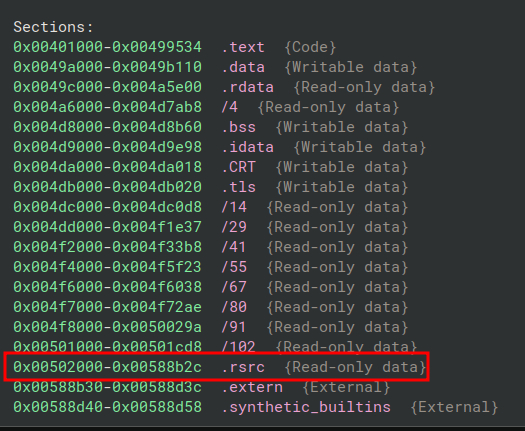
.text → 200 KB (Executable code)
.data → 50 KB (data, ok)
.rsrc → 539 KB WTF?!
539 KB of resources… In a 1.5 MB console executable… yeah, right.
For reference, .rsrc is supposed to contain legit stuff: icons, Windows dialogs, UI strings, etc. Normally just a few KB, rarely over 100 KB.
Here, we have half a megabyte of data. And looking more closely: no structured icons, no dialogs, no multilingual strings… Just a big binary blob with very high entropy (7.8/8.0).
Almost certainly encrypted.
Strings & Ciphers
First step: look at the strings — we quickly stumble onto:
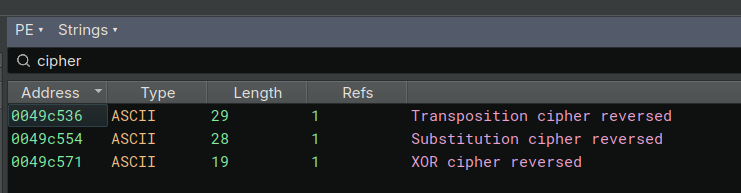
Jackpot !
1 | "XOR cipher reversed" |
Not subtle at all…
We also notice many anti-debug related strings, plus classic malware stuff (AMSI patch, sandbox detection, etc). The logging is very verbose — they probably forgot to remove debug messages…
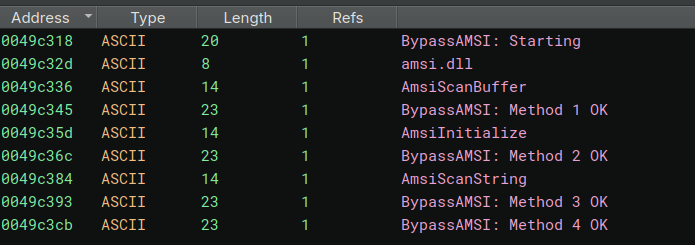
With the xrefs, we can identify the method that “decrypts” something:
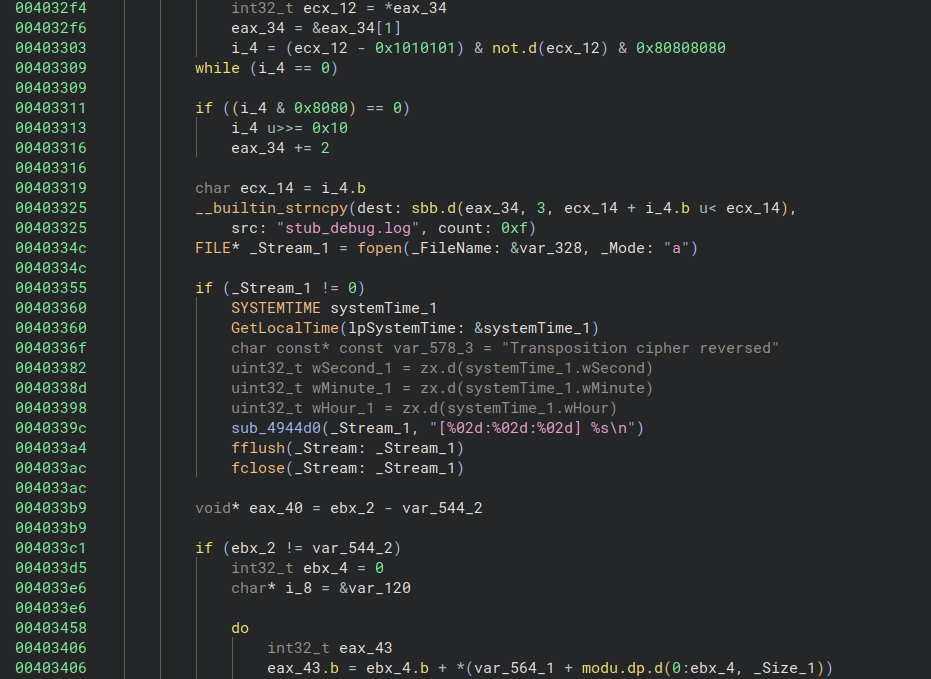
This function is fairly large, with many memcpy/malloc, lots of loops, strongly suggesting a “decryption” routine.
Looking at where it’s called, we see another heavy function that — surprise — fetches data from .rsrc before calling decryption…
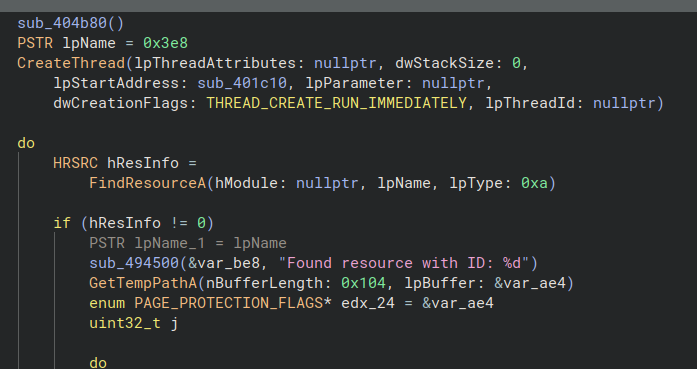
Cleaning up all the AMSI, ETW, etc. patching calls, it looks like:
1 | ... |
Clearly, it scans resources for a specific one, checks sizes, decrypts it, and executes the output — classic.
Decrypt
Now we need to extract and decrypt the payload to understand the malware behavior.
According to the embedded debug strings, the algorithm is in 3 stages:
- Transposition cipher reversed
- Substitution cipher reversed
- XOR cipher reversed
Payload extraction
First, we extract the payload.
The dropper pulls resources of type 0xa.
Using debug strings and size checks, we can infer the header structure:
1 | "Header parsed - headerSize: %d, blockSize: %d, keySize: %d, encryptedSize: %d" |
There’s also a check:
1 | 004062fd if (_Size u<= 0x31) |
From this, we deduce a header like:
- headerSize : between 8 and 15 bytes
- blockSize : probably 16
- keySize : probably 32
The rest looks like key + encrypted data.
Looking inside .rsrc, we quickly find a blob matching the format (right after standard resource structs):
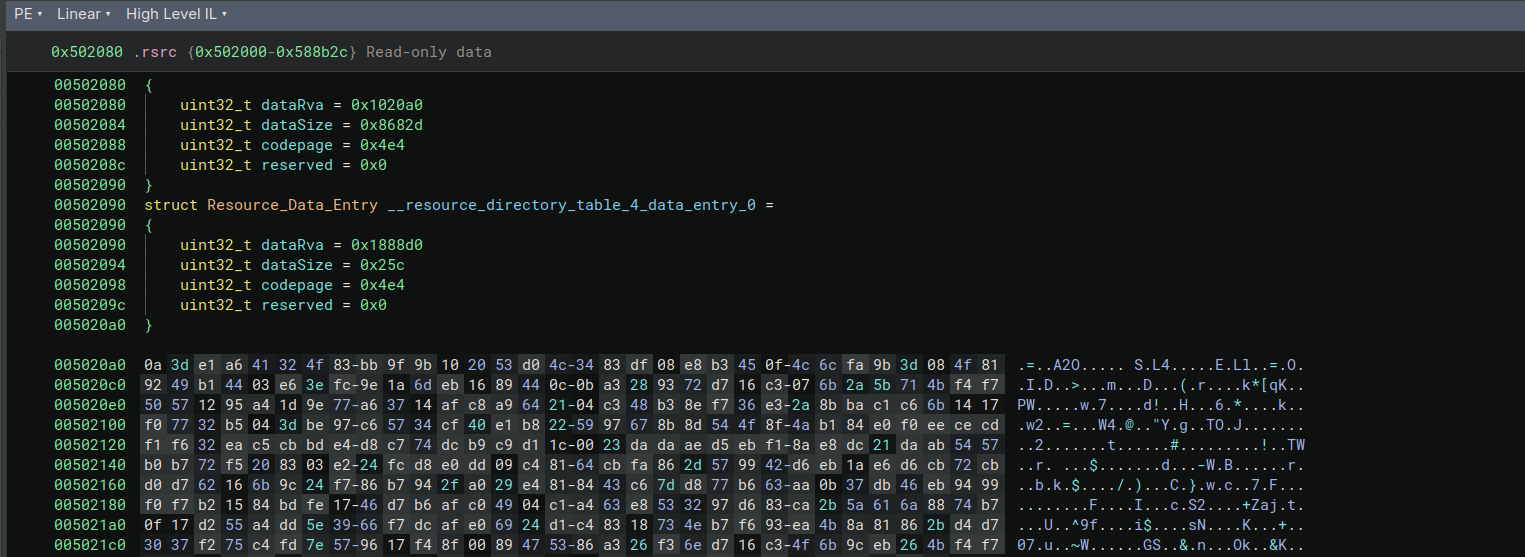
We also see buffers similar to:
1 | struct DataBuffer |
Then the 3 decryption steps start.
Transposition
This one is simple: data is processed in 16-byte blocks and each block is reversed.
1 | Input: [00 01 02 03 04 05 06 07 08 09 0A 0B 0C 0D 0E 0F] [10 11 12 ...] |
Easy
Substitution
This part is trickier.
It uses a dynamic substitution table built per-byte using the key.
- Compute
base = (i + key[i % keySize]) % 256 - Build table:
table[j] = (base + j) % 256 - Find inverse:
find j such that table[j] == encrypted_byte - Replace byte with
j
It’s more obfuscation than encryption.
Thanks to debug strings, it was much easier to understand :D
As simple as a XOR
Final step: classic XOR loop using the 32‑byte key.
Let’s decrypt
Running all 3 steps on the extracted payload gives:
1 | def reverse_transposition(data, blockSize): |
We indeed get another binary!
1 | ghozt@maze:~/research/malware$ file output.exe |
.NET stealer
With ilspy we extract the C# code:
1 | ghozt@maze:~/research/malware$ ilspycmd output.exe -o ./decompiled_dotnet/ |
We quickly notice the strings are obfuscated.
Still, we can analyze the general behavior: credential theft, Discord token extraction, decrypting Chrome’s password store via DPAPI…
As for the strings, everything is AES‑encrypted with a lightly obfuscated key:
1 | public static class Strings |
There are 190 encrypted strings.
All use AES‑CBC, but with a twist: ciphertext is reversed before decryption.
AES keys themselves are XOR’d then Base64‑encoded.
Reproducing the algorithm gives:
1 | AES Key: OFhBENNkSFZaYyg2w6yQi5Mrqn7ypiPXDrim64w/FM0= |
And we can decrypt everything!
Targets and data theft
Browsers :
1 | Login Data → Credentials Chrome/Edge/Brave |
Messaging :
1 | discord\Local Storage\leveldb\ → Discord Tokens |
Crypto Wallets :
1 | wallet.dat → Bitcoin Core, Litecoin |
VPN :
1 | NordVPN\user.config |
Gaming & FTP :
1 | Steam\loginusers.vdf |
And the big one:
1 | net.tcp://185.172.128.70:3808 |
This is the C2 where all stolen data is sent using WCF (Windows Communication Foundation).
System recon
The malware also collects lots of system info:
1 | SELECT * FROM Win32_Processor -- CPU |
And detects security products:
1 | ROOT\SecurityCenter\AntivirusProduct |
Overview
With all strings decrypted, we can reconstruct the complete workflow:
Phase 1 : Recon
- System info (CPU, GPU, RAM, disks, OS)
- Security product detection
- VM/sandbox checks (QEMU, RDP)
- Running processes
- Installed software
- GeoIP via https://api.ip.sb/ip
Phase 2 : Data theft
- Browsers: credentials, cookies, autofill, credit cards
- Discord: tokens via LevelDB
- Telegram: tdata folder
- Wallets: crypto wallet files, extensions
- VPN: configs for NordVPN/ProtonVPN/OpenVPN
- FTP: FileZilla
- Gaming: Steam login data
Phase 3 : Exfiltration
- Compress stolen data
- Connect to C2: net.tcp://185.172.128.70:3808
- Send via WCF binary protocol
Persistance
One encrypted Base64 string decodes to another .NET executable, which is written into the Startup folder:
1 | using System; |
This is likely a dormant backdoor allowing later reattachment.
Conclusion
This sample appears to be a variant of Reline, a fork of RedLine Stealer that surfaced after the October 2024 takedown.
It features:
- Custom packer with simple ciphers (transposition + substitution + XOR)
- WCF exfiltration instead of SOAP/HTTP
- Debug strings left in
- Obfuscated .NET payload
IoCs Summary
1 | Dropper: |